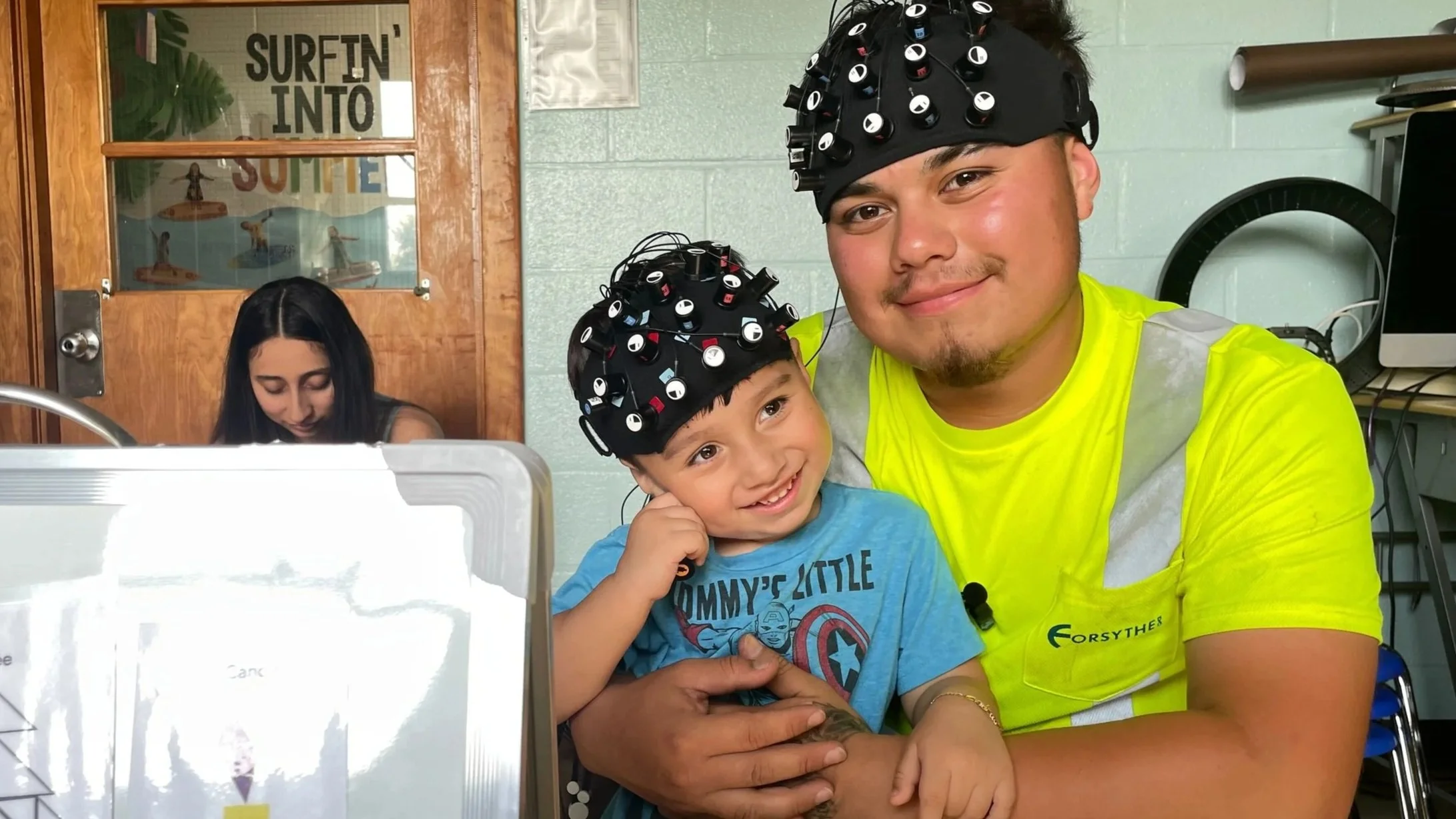
I study how babies and toddlers develop emotionally in their daily relational ecosystems.
Human development relies on millions of daily, moment-to-moment interactions with parents, grandparents, educators, and other caregivers.
As a developmental cognitive and affective neuroscientist, I study the brain-behavior mechanisms shaping children’s emotional development in their early relationships.
As a policy advocate, I help translate existing science into publicly funded programs (child care, pre-K, Head Start) to ensure that all young children have access to ideal learning environments that support their development. I am also engaged with and concerned about the rapid influx of AI toys and bots into babies’ lives.
I occasionally consult as a strategist on projects related to the protection and expansion of democracy in the US, and I am interested in building bridges between affective science and political strategy for progressive causes.
I am committed to racial equity and inclusion in science and policy.

LEAD Lab, University of Maryland
2022 – Present
Working with Dr. Rachel Romeo, I am leading a caregiver-toddler two-brain fNIRS study investigating:
how caregiver-child prefrontal cortex synchrony varies in the context of proximal and distal stressors
how variability in caregiver sensitivity relates to caregiver-child prefrontal cortex synchrony across stressor contexts
how synchrony across prefrontal cortex synchrony and emotional behavior are related to children’s emotion regulation skills
Publications:
Roche EC, Redcay E, Romeo RR. 2025. Caregiver-child neural synchrony: Magic, mirage, or developmental mechanism? Developmental Cognitive Neuroscience. Developmental Cognitive Neuroscience, 71, 101482. https://doi.org/10.1016/j.dcn.2024.101482
Early Learning Project, Georgetown University
2020 - 2022
Working with Dr. Rachel Barr, I published several analyses of infant affective state during video chat Zooms with grandparents during COVID-19.
Publications:
Roche, E. & Piper, D., Strouse, G., Myers, L., Zosh, J., Troseth, G., Barr, R. 2026. “Mutual Sensitivity Between Caregivers Predicts Infant Affective State During Video Chat.” Infancy, 31(1), e70068. https://doi.org/10.1111/infa.70068
Roche, E., J. Rocha-Hidalgo, D. Piper, et al. 2022. “Presence at a Distance: Video Chat Supports Intergenerational Sensitivity and Positive Infant Affect During COVID-19.” Infancy 27, no. 6: 1008–1031. https://doi.org/10.1111/infa.12491.
Strouse, G. A., McClure, E., Myers, L. J., Zosh, J. M., Troseth, G. L., Blanchfield, O., Roche, E., Malik, S., & Barr, R. (2021). “Zooming through development: Using video chat to support family connections.” Human Behavior and Emerging Technologies, 268(4), 552–571. hbe2. https://doi.org/10.1002/hbe2.268
Trust for Learning
2018 - present
At Trust for Learning I support a community of advocates around the country to translate developmental science into policy and philanthropic practice.
I serve on the Steering Committee for the Early Relational Health philanthropic working group, the Racial Equity committee of the Early Childhood Funders Collaborative, and the Council on Addressing Racism in the Early Years hosted by Boston University, UNC Chapel Hill, and Harvard University.
Publications:
Science Translation
Book talk: Kathy Hirsh Pasek
In March of 2026 I interviewed Dr. Kathy Hirsh-Pasek in collaboration with Trust for Learning, Hunt Institute, and the National Center for Montessori in the Public Sector.
Behind the scenes in ideal learning environments
In 2025 I interviewed two extraordinary early childhood leaders - Ellicia Lanier of Urban Sprouts and Allyx Schiavone of Friends Center - to understand how they’ve created ideal learning environments in their communities.